Functional
Neurological Disease
Signs
Hoover’s Sign
Two parts/types:
Normal power in hip extension in the ‘weak’ limb
when the patient is asked to flex the ‘normal’ limb.
-
Demonstrates that ‘weak’ leg is able to generate force
Weakness of hip extension in the ‘normal’
contralateral limb when patient is asked to flex the ‘weak’ limb.
-
Demonstrates lack of effort
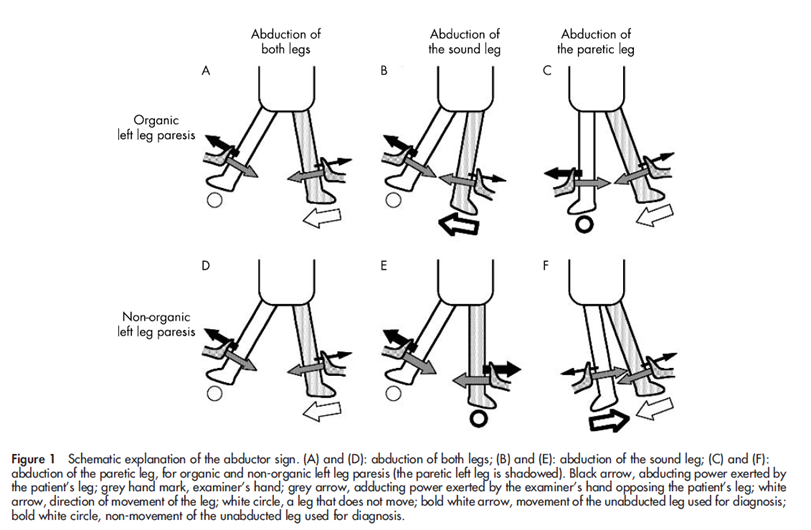
Abductor Sign
(Sonoo, JNNP 2004; 75 121-125)
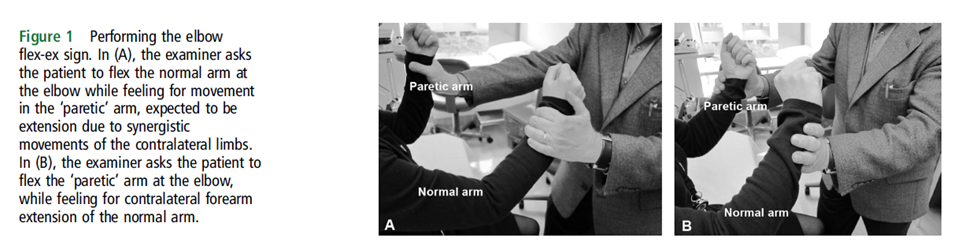
Elbow Flex-Ex Sign
(Lombardi et al. JNNP 2014 85: 165-167)
BARRE SIGN (MANOEUVRE DE LA
JAMBE)
The patient lies in a pronated position, legs
flexed (knees
touching the bed): the weak leg stays in position
(instead
of slowly falling, as in organic weakness) or
instantly
drops without any contraction of the hamstrings
STERNOCLEIDOMASTOID TEST
In a stroke, sternocleidomastoid weakness is
relatively
unusual as the innervation is bilateral. However,
if there
is weakness then you would expect that to be of
head
turning to the contralateral side. In some patients
with
functional hemiparesis there is weakness of head
turning
to the ipsilateral side (Diukova
et al., 2001).
FINGER ABDUCTION
This tests synkinetic
(fifth-finger abduction) movement
of the weak hand during abduction of the healthy
fingers
(contralateral hand) against resistance (Tinazzi et al.,
2008). This may be useful in patients with complete
paralysis of the hand.