Thrombolysis
PROTCOL
Inclusion criteria
·
Onset of ischaemic stroke within the preceding 4.5 hours
·
Measurable and clinically significant neurological deficit on National
Institute of Health Stroke scale examination (as a guide, NIHSS >4,
dysphasia, visual field defects)
·
Patient’s head CT scan does not show haemorrhage or non-vascular cause of
stroke symptoms
·
Patient’s age is >18 years
Exclusion criteria
ABSOLUTE – DO NOT
administer alteplase if any of the following
statements are true:
·
Uncertainty about time of stroke onset (e.g. patients
awaking from sleep)
·
Coma or severe obtundation with
fixed eye deviation and complete hemiplegia
·
Only minor stroke deficit which is rapidly improving
·
Seizure observed or known to
have occurred at onset of stroke
·
Hypertension: ≥185/>110 mmHg
on repeated measures (unresponsive to single dose IV treatment)
·
Clinical presentation suggestive of SAH even if the CT scan
is normal
·
Presumed septic embolus
·
Patient having received heparin within the last 48 hours
and has elevated APTT or has a known hereditary or acquired haemorrhagic
diathesis (e.g. PT or APTT greater than normal)**
·
INR >1.7**
·
Serum glucose <2.8 mmol/L or >22.0 mmol/L (hypo
and hyperglycaemia may cause symptoms mimicking stroke).
ABSOLUTE
contra-indications for between 3 and 4.5 hours after stroke onset
(as
patients with these features were excluded from the ECASS3 study)
o
age >80 years
o
Oral anticoagulant treatment
o
Combination of previous stroke and diabetes mellitus
o
Severe stroke as assessed clinically (NIHSS >25) or with brain imaging
findings indicating involvement of >1/3 of the middle cerebral artery
territory
RELATIVE CONTRAINDICATIONS
·
Severe neurological impairment with National Institute of Health Stroke
Scale score >22
·
CT evidence of extensive middle cerebral artery territory
infarction (sulcal effacement or blurring of
grey-white junction in >1/3 of middle cerebral territory)
·
Stroke or
serious head trauma within the past 3 months where the risks of
bleeding are considered to outweigh the benefits of therapy
·
Platelets less than 100
·
Major surgery within the last 14 days
·
Known history of intracranial haemorrhage, SAH, intracranial AVM or
previously known intracranial neoplasm that, in the opinion of the
clinician, the increased risk of intracranial bleeding would outweigh the
potential benefits of treatment.
·
Suspected recent (within 30 days) myocardial infarction
·
Recent (within 30 days) biopsy of a parenchymal organ or
surgery that, in the opinion of the responsible clinician, would increase the
risk of unmanageable (e.g. uncontrolled by local pressure) bleeding.
·
Recent (within 30 days) trauma with internal injuries or
ulcerative wounds
·
Gastrointestinal
or urinary tract haemorrhage within the last 30 days or any active or recent
haemorrhage that, in the opinion of the responsible clinician, would increase
the risk of unmanageable bleeding.
·
Arterial
puncture at a non-compressible site within the last 7 days
·
Pregnancy
·
Concomitant serious, advanced or terminal illness or any other condition
that, in the opinion of the responsible clinician would pose a significant
hazard, or where prognosis of co-morbidities would overshadow potential
benefits of thrombolysis
Note, the following ARE NOT contra-indications to rtPA:
·
Recent TIAs (deficits fully resolved)
·
Prior aspirin or clopidogrel use
Process
HTN
If HTN to start with try:
·
Metoprolol
2.5mg IV
·
Hydralazine
5mg IV
·
GTN
patch 5mg
Alteplase
Dose is 0.9mg/kg
(maximum dose 90mg) given as:
·
10% of total dose
given as a bolus over 1 minute
·
the remaining 90%
as an infusion over 60 minutes
·
hang 100 mls of normal saline at end of dose to ensure the full dose
of alteplase is administered
Post-lysis management
·
No antiplatelet or
anticoagulant agents to be given for 24 hours after treatment
·
Placement of NG tubes, urinary catheters,
venepuncture or other invasive procedures should be avoided.
·
Obtain blood from
IV bung if possible. If venepuncture is required, apply direct pressure for 20
minutes
·
BP should be
maintained at <185 systolic and <110 diastolic for 36 hours following alteplase treatment
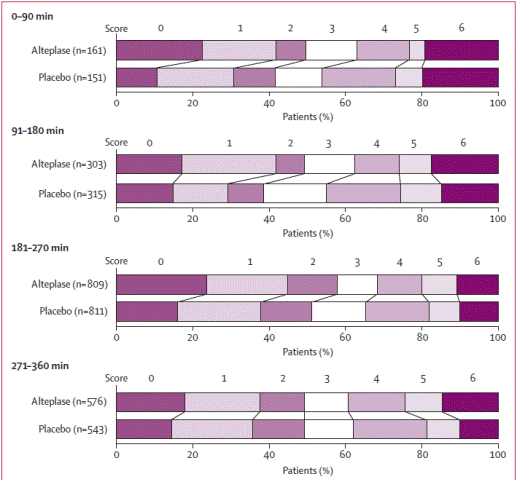
Pathophysiology
·
Every
10min, 20million neurones will die in a typical infarct in the MCA territory
(Lancet 2010, 375:1667)
Outcomes
Benefits
|
Time (min) |
OR |
ARR |
NNT |
|
0-90 |
2.81 |
12% |
8.3 |
|
91-180 |
1.55 |
13% |
7.6 |
|
180-270 |
1.4 |
6% |
16.7 |
From Lancet 2010 combined results:
Modified Rankin 0-1 at 90days
|
Time (min) |
OR |
ARR |
NNT |
|
0-90 |
2.55 |
4.5 |
|
|
91-180 |
1.64 |
9.0 |
|
|
180-270 |
1.34 |
14.1 |
|
|
271-360 (not signif) |
1.22 |
21.4 |
|
|
0-360 |
1.4 |
12.6 |
Risks
Intra-Cranial Haemorrhage
·
Fatal
ICH OR 3.6
o
Base
line ~1% increased to 4% (i.e. 33 extra per 1000 treated)
·
Definition
differs in terms of ‘symptomatic haemorrhage’ (Australian data presented below)
o
SITS-MOST
– large (type 2) infarct related haemorrhage or remote haemorrhage with
decrease of 4 points in NIHSS
§
1.3%
o
ECASS
– any haemorrhage and decrease of 4 points in NIHSS
§
6.6%
o
RCTs
– Any haemorrhage and decrease of 1 point in NIHSS
§
8.3%
o
·
Overall
in metanalysis - Symptomatic ICH OR 3.13
·
In
combined NINDS/ECASS analysis:
o
Type
2 haemorrage seen in 5.9% vs
1.1%
·
Factors
associated with risk of haemorrhage include:
o
Age
o
Established
infarct on initial CT
o
Treatment
delay and premorbid function of borderline significance
Mortality
·
Overall data OR 1.17 (NS)
·
Australian
data OR1.04 (NS)
·
May
be a higher death rate in first two weeks which is balanced out with better
survival in remainder such that by 3 months roughly equal.
Cochrane meta-analysis
·
OR
for death or disability 0.8
·
Equivalent
to 55/1000 additional independent survivors
Special Groups
·
Old
Young
·
More
likely to do well:
·
Toni D et al. Intravenous thrombolysis in young
stroke patients: Results from the SITS-ISTR. Neurology 2012 Mar 20;
78:880